Strature Briefs
One question per brief, answered with a probability we register and score. The summary sheet and the executive read are free.
Strature advises organisations on geo-strategy and geo-business strategy, and measures their exposure to regulation, sanctions and policy where they actually operate.
One question per brief, answered with a probability we register and score. The summary sheet and the executive read are free.
The questions our briefs address, on the world map, with country pages, strait scenarios and the supply network.
What can reach one company, where and when. Four demo editions, read from public sources.
Work for one organisation: geo-strategy, geo-business strategy, forecasts and briefings for a board.
Narrated films. Nothing plays until you press play.
From far enough away, the world looks calm. Come closer, and the order it runs on is being rewritten. A company earns in one country, sources in another, borrows in a third. Each has its own rules, its own currency, its own politics. Risk comes from many directions. Geopolitical: war, alliances, rival states. Geoeconomic: tariffs, sanctions, the price of money. Geotechnology: chips, data, export controls. In EY's survey, fifty-six per cent of chief executives named geopolitical uncertainty their biggest business risk. Everyone reads the same headlines. Not everyone has the same exposure. Strature starts there: one company, where it actually operates.
Take a bank. Here is our exposure work on Royal Bank of Canada, from public sources. RBC is the subject of the analysis, not a client. Thirty-four thousand rows of official text, read. Forty-one written up, each quoted and dated. Each weighed by where the bank earns. Places not read are printed as gaps, not zeros. Now a mining group, across Asia and Africa. Its exposure runs through each host country: licences, royalties, export rules, and politics. Some questions resolve in months. Others take years. Country briefs read each country as a whole. And forecasts, so the group can prepare early.
A manufacturer, shipping across a border. Its exposure is set by the tariff line, not the sector. Question briefs answer decisions like this. Follow a chip. From minerals, to servers, to data centres, to AI. AI draws capital, and grid power. Export controls hit one link. Sanctions, another. Conflict, another. Pull one thread, and the whole web moves. Trace an export control. Chip supply slows. Servers and data centres cost more. A company's AI plans, and its capital costs, shift. Seen early, a shock becomes a choice. We untangle it into a few strategic insights, and options to consider. A shipowner and its insurers: a chokepoint narrows, war-risk premiums move. Our brief asked: was Hormuz closed, or repriced cargo by cargo? Repriced. These are examples. Strature works across every sector. The questions stay the same: what can reach us, and what comes next?
This is what Strature does. Exposure assessments: what can reach a company, where it actually operates. Reach: what can touch the company. Weight: how much of its revenue is exposed. Time: what to act on, prepare for, or watch. A dashboard, a brief and a deck, through a pilot of six to twelve months. Question briefs answer one question at a time. Country briefs give the big picture for one country. For clients, we write both to order: their own questions, their own countries. Under an engagement, we link a client's exposure to what may come next. Every forecast is registered before the fact, and scored when it resolves. We make no claim about their quality until the register can show it.
One method, six frameworks, each feeding the next. Systems theory: the big picture, and how the system shapes decisions. Game theory: how players act strategically, and which scenarios could follow. Political psychology and behavioural decision-making: how players really decide, rational or not. Futures studies and scenario planning combine long-run trends with the players' strategies: possible and probable scenarios. Statistics and probability: historical patterns put a probability on each scenario. Mathematical optimisation finds the strategies that hold up best across all the scenarios. All six draw on nine fields. Behind it, tools we have built: base rates, count models, minimax regret, and a sealed forecast register. Options to consider. The decision stays yours. Tell us the decision you are facing. Strature dot net.
The world order is changing. Regulation, sanctions, trade measures, technology rules: each one reaches a company somewhere it operates.
Strature is a consulting and forecasting firm in Toronto. It works on the things that matter in the changing world order: geopolitical, geoeconomic, and geotechnology.
For an organisation, that means three questions. What can reach us? Where does it bite? What is dated? An exposure assessment answers them, weighted by where the company earns its revenue.
Strature Advisory works with one organisation at a time: geo-strategy, where to be and where not to be; geo-business strategy, what the picture means for one business; forecasts and scenarios; and briefings for a board.
Strature Briefs is a published series. Each brief asks one question that can be settled, and answers it with a registered probability. Every probability is our estimate, scored when it resolves.
Four rules hold the work. Nothing is invented. A retrieval asserts its own completeness. A scan of nothing is not a clean scan. And a conflict is printed, not resolved.
Strature. strature.net. General research, not advice.
For eighty years, business took the world for granted. Not any more. The rulebook of nineteen forty-five is being torn up. Not one crisis. All of them, at once.
Fought in one region. Priced in every port. Tariffs at the border. Subsidies for the chip plant. Globalisation is splitting into blocs. Reserves are shifting.
Millions are uprooted. Code is writing code. In EY's survey, fifty-six per cent of chief executives named geopolitical uncertainty their biggest business risk.
But risk is only half the ledger. Every break creates losers. And winners. New routes. New grids. New signatures.
Those who prepare keep a second route. When one lane shuts, they can find the next. Strature is built for this. A map of the questions that matter, country by country.
One company's exposure, read from public sources. Briefs that take one question at a time. A new order is being drafted now. Take nothing for granted.
Each brief answers one question. The summary sheet and the executive read are free to everyone; the full brief is supplied to organisations, free during the introductory period.
Today C$0.14bn is checkable; TD states an amount against its C$150bn pledge by mid-2027 at 17%, our estimate, set by the firm, scored when it resolves.
Likeliest to 2029: confrontation and a law he signs, 33%, our estimate, set by the firm, scored when it resolves.
More likely at or below plan. A 2026-27 deficit above plan by 31 December 2027, two scenarios together: 25%, our estimate, set by the firm, scored when it resolves.
A 2027 rise in business investment, its two scenarios together, is 42% by 31 March 2028, a flat year 31%, our estimate, set by the firm, scored when it resolves.
Every question our released briefs answer, placed on the countries it touches, the answer quoted verbatim. Strature GPS has a page for each of the 201 countries our released work addresses.
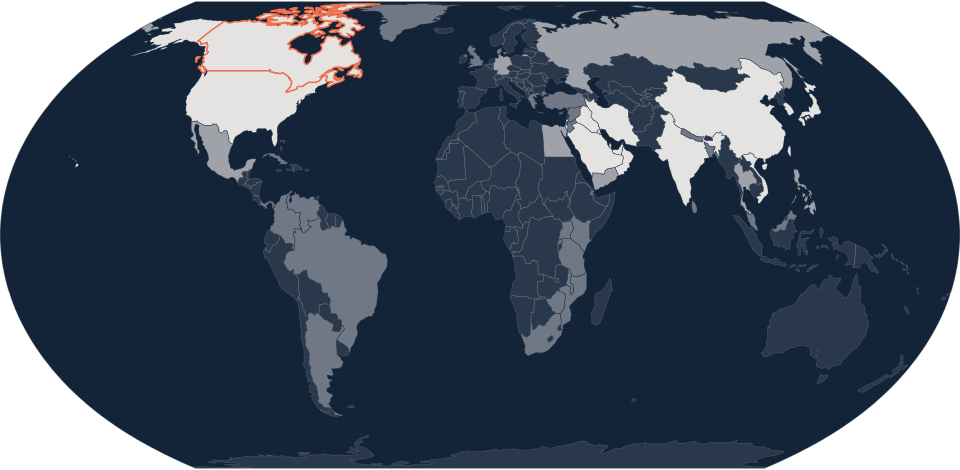
Every country we cover, by region, with the risks that reach it.
Event risks and strait closures, each with our forecasts and who is exposed.
What crosses which strait, and who depends on it.
Every probability we publish, registered first and scored when it resolves.
The bank’s edition of 28 Sep 2026 assesses 41 changes that can reach RBC: six rules already in force, four comment periods that closed by 14 Oct, and six more dated by 31 Dec 2026.
Restated from the edition’s summary, Strature Exposure, RBC, 28 Sep 2026
The regulations, bills, trade measures, sanctions and policies found for a company where it operates, weighted by where it earns its revenue, with every place not read printed as a gap, each with its official text and the options it opens. Re-issued as an edition.
RBC is the subject of the analysis, not a client. No endorsement by RBC is implied. Figures: edition of 28 Sep 2026, built from public sources.
Canada alone is more than half of the bank’s revenue, so a Canadian rule carries more weight in its exposure picture than an American one, and one from elsewhere less again.
Royal Bank of Canada. 41 assessed changes; 36 of them carry a date. With a narrated video of 8 Oct 2026.
Magna International. Eight changes; three of the four rated major hinge on a fact about the company. With a narrated video of 8 Oct 2026.
DP World. Six changes, each waiting on a fact about the company before it is ranked. With a narrated video of 8 Oct 2026.
Suncor Energy. 57 assessed changes; seven lead the edition. With a narrated video.
Built by Strature from public sources. None was commissioned by, reviewed by or affiliated with the company it reads.
Geopolitical, geoeconomic and geotechnology advisory for a company, an investor or a board. Strature never recommends securities.
Where to be, and where not to be, as the world order changes.
What the geopolitical picture means for one business and its footprint.
A decision answered with dated observables and a registered probability.
A board or leadership session, in person, built from your exposure picture.
The first are scored on 4 Dec 2026. See the register
A principal-led firm, founded 2026.
Every forecast is registered before the fact and scored when it resolves, good or bad.
Each item cites its official text; every place not read is printed as a gap.
An exposure assessment of your own company, free. Request a pilot.

Milad Naeimi
Principal, Strature
Milad Naeimi, Principal of Strature, built its method and platform to show companies how regulation, politics and sanctions reach their operations.
About the PrincipalThe Principal reads every message and replies from the firm’s own address. Your message is never added to a mailing list unless you tick the box to be kept informed. No tracking of people: we count visits and downloads without cookies.