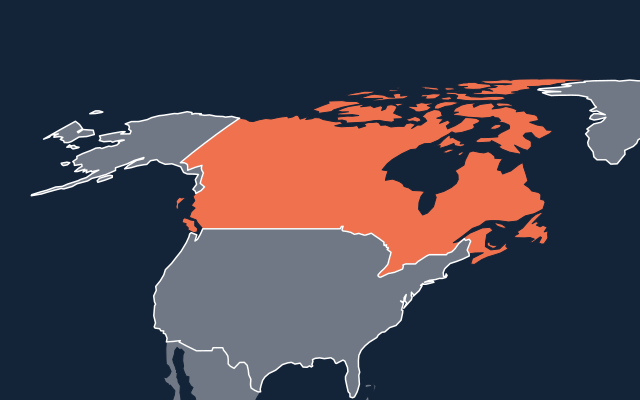
The questions our published briefs answer that touch Canada.
Filter the questions Domain · Series
DomainSeries
About Canada (primary)
Decision Brief · Q-021 · 21 questionsCan Canada turn promised capital into built projects?
Geoeconomic
Can Canada turn promised capital into built projects?
“Not quickly. A fund we track taking a C$1bn-plus build stake by 31 October 2027: 43% (16% with a government term, 27% without), our estimate, scored when it resolves.”
Have the funds put their Canadian money into operating assets or new builds?
“Since September 2020 the funds we track have closed 14 counted deals in Canadian infrastructure. Of these, 12 were in operating assets or in businesses that operate and build at once”
The brief’s reading of the evidence; not a registered forecast.
Do foreign managers and sovereign investors invest in Canadian infrastructure?
“Foreign fund managers already own and buy Canadian infrastructure, but we found no closing by a foreign sovereign investor from the pledges to 27 September 2026.”
The brief’s reading of the evidence; not a registered forecast.
“By an anchor deal we mean a first large transaction by the Maple Fund, which other funds might follow. For the Maple Fund, up to C$50bn from CPP Investments and Brookfield, we found no transaction by 27 September 2026.”
The brief’s reading of the evidence; not a registered forecast.
How many undecided large projects suit an infrastructure fund?
“Only 9 are paid for providing a network or facility service: gas pipelines, gas export terminals, a hydro expansion, a hydro-fibre link and a carbon-storage hub.”
The brief’s reading of the evidence; not a registered forecast.
Do projects with a government term go ahead more often?
“Counting only terms in place when the decision was taken, projects with a published or signed government term went ahead 6 times in 15 (40%), against 12 in 58 (about 21%) without.”
The brief’s reading of the evidence; not a registered forecast.
“The two futures with a new build stake by a fund we track, with or without a government term, come to 43% together, our estimate, scored when it resolves.”
Do the two Canadian publishers agree on monthly LNG exports?
“For July 2026 the regulator lists 0.70 bcm from Kitimat and the agency 1.21 bcm of non-US gas exports, 42.2% apart. Across July 2025 to July 2026 the two agree within 1% in 6 of 13 months.”
The brief’s reading of the evidence; not a registered forecast.
“No route used for this brief publishes a project-by-project register of what is under construction, with a capacity and a date, at the standard the flow data meets.”
The brief’s reading of the evidence; not a registered forecast.
What pulls Canadian exports back towards the United States?
“The first is geography made durable by capital: the pipeline network to the United States is built, and the measured Pacific marine route is one dock for crude and one terminal for nearly all the gas.”
The brief’s reading of the evidence; not a registered forecast.
“The absolute numbers are small and the denominators are large. Over the 12 months to July 2026 the non-US gas flow was 11.34 bcm and the non-US crude flow 32.6 million m³.”
The brief’s reading of the evidence; not a registered forecast.
What is the political and regulatory risk to Canadian energy exports?
“No source used carries regulatory decisions, policy positions, permit status or intergovernmental agreements at the standard the rest of this brief meets.”
The brief’s reading of the evidence; not a registered forecast.
How concentrated is the selling side of Canada's LNG exports?
“Of 122 export cargo records from Kitimat, all are long-term and all name a single licence holder. The buyer base is spread across seven destinations; the seller base is one.”
The brief’s reading of the evidence; not a registered forecast.
What else does Canada ship to the same Asian destinations?
“UN Comtrade records China, Japan and Korea as the largest 2025 destinations of Canadian coal and of ores, slag and ash; they are also the three largest destinations of the gas cargoes”
The brief’s reading of the evidence; not a registered forecast.Affected China +2
Theme Brief · T-002 · 15 questionsIs the Northwest Passage becoming a shipping lane?
Geoeconomic · Geopolitical
Is the Northwest Passage becoming a shipping lane?
“Not on the published record: 6 of the 35 full transits in 2025 were commercial, and Canada publishes no Arctic icebreaking fee, so the Coast Guard sells no Arctic escort slot.”
The brief’s reading of the evidence; not a registered forecast.
Is growing Arctic shipping the same as growing Northwest Passage transit?
“PAME's count is overwhelmingly destination traffic: community resupply, mine supply, fishing and cruise segments that arrive and leave the way they came. Its growth says little about ocean-to-ocean transit.”
The brief’s reading of the evidence; not a registered forecast.
Does the London war-risk market list the Northwest Passage?
“The Joint War Committee's current listed areas, circular JWLA-035 of 16 September 2026, contain no Arctic, Canadian, Baffin, Beaufort, Barents, Bering or polar entry.”
The brief’s reading of the evidence; not a registered forecast.
Does the Northwest Passage offer a shorter route between Europe and Asia?
“A 2017 review for the UK Government Office for Science describes the Passage as a route from the US East Coast to Asia, and the Northern Sea Route as the Europe to Asia route.”
The brief’s reading of the evidence; not a registered forecast.
What does the Nunavut Agreement govern on Northwest Passage waters?
“In the Nunavut Settlement Area, the Nunavut Agreement governs what is built and operated; ship movements not tied to a project are outside its screening.”
The brief’s reading of the evidence; not a registered forecast.
What changed in Canada's Arctic ship reporting rules in 2026?
“The Vessel Traffic Services Zones Regulations, SOR/2025-275, published in the Canada Gazette on 31 December 2025, came into force on 31 March 2026 and consolidate three regimes into one.”
The brief’s reading of the evidence; not a registered forecast.
When does the Arctic heavy fuel oil ban fully apply?
“Ships with protected tanks may continue until 1 July 2029, and a coastal state may waive the rule for its own-flag ships in its own waters until the same date.”
The brief’s reading of the evidence; not a registered forecast.
Decision Brief · Q-024 · 12 questionsCanada–US trade: who is exposed
Geoeconomic · Geopolitical
Who is exposed to the US measures on Canadian goods, and to which instruments?
“Exposure is set by the tariff line, not the sector: 666 US lines carry the Section 338 duty of 50 per cent, and 68 are excluded from importation since 29 September 2026.”
The brief’s reading of the evidence; not a registered forecast.
How many US tariff lines carry the 50% Section 338 duty, and is the largest list a sector?
“Heading 9903.03.14 holds 513 lines. Its four largest groups are wood (64 lines), furniture (56), electrical goods (39) and paper (31): 190 of 513, or 37%.”
The brief’s reading of the evidence; not a registered forecast.
What does the US exclusion from importation of 29 September 2026 reach?
“Proclamation 11063, titled with respect to motor vehicles, excludes one tariff line from importation: motorcycles over 800 cc. It reaches no cars, trucks or parts.”
The brief’s reading of the evidence; not a registered forecast.
Whose conduct do the Section 338 proclamations name?
“For lines on 9903.03.13 and 9903.03.14, the measures the United States names are a federal quota allocation and a federal Order in Council (SOR/2025-118), both published.”
The brief’s reading of the evidence; not a registered forecast.
“The reading would change with a new proclamation amending the exclusion annexes or the duty lists, or a revision of U.S. note 51; none was found to 30 September 2026.”
The brief’s reading of the evidence; not a registered forecast.
Country Outlook · C-004 · 3 questionsIs the main US risk for business now US policy itself?
Geoeconomic
How did US tariff authority change in 2026?
“The source's reading holds on the new record: tariff exposure in 2026 is set by which statute is in force, which tier a partner sits in and whether goods qualify, not by a stable schedule.”
The brief’s reading of the evidence; not a registered forecast.
Has the Western Hemisphere balanced against the United States?
“No balancing coalition formed: Argentina aligned with Washington, Mexico and Canada hedged, Brazil opened a trade track with China, and Colombia broke with Washington rhetorically.”
The brief’s reading of the evidence; not a registered forecast.Primary United States Affected Argentina +8
How do Mexico and Canada differ in their exposure to US policy?
“For the source, the region reaches business through the USMCA perimeter rather than through the border itself: qualification decides most of the tariff bill, and the first measures that ignore qualification fell on Canada.”
The brief’s reading of the evidence; not a registered forecast.
Each answer is quoted verbatim from the brief. Answers with a register ID are our estimates, scored when they resolve; the others are the brief’s reading of the evidence, not forecasts.
Regions in these questions Arctic · East Asia · Europe · Latin America · Middle East · North America · Southeast Asia
ISO 3166-1 name: Canada (CAN). Country and territory names follow common usage and imply no position on sovereignty.
The one-page sheet and the executive read are free.
The full brief is supplied to organisations through the request form on the brief’s page: they accept its terms and confirm a work email, and it is free during the introductory period.
General research for general circulation; not investment, legal or tax advice and not tailored to any reader. Every probability is our estimate, scored when it resolves.
Ask about Canada
A question this page does not answer?
Suggest it for the series; if we take it up, the answer is published to everyone.