Gulf war / Hormuz · Strature analysis, not from the brief
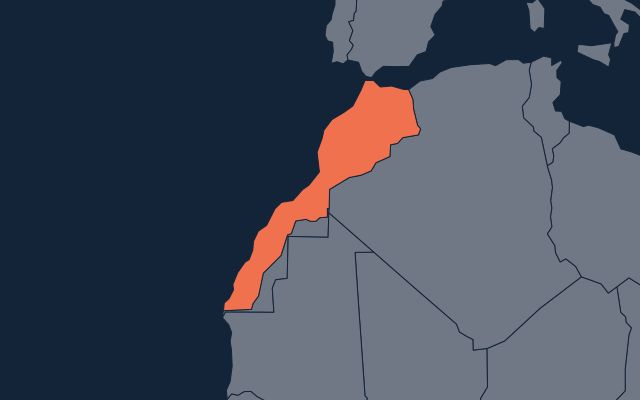
Gulf war / Hormuz: what is at stake for Morocco
Morocco gains and loses: OCP needs Gulf sulphur and ammonia (47.9% and 33.6% of imports) but can replace Gulf phosphate, about US$1.36bn a year extra at September's DAP price, our estimate, scored when it resolves.
47.9%
Gulf share of sulphur imports (2024)
33.6%
Gulf share of ammonia imports, Oman excluded (2024)
US$9.977bn
Fertiliser exports, US$ bn (2024)
US$1.36bn
Extra DAP revenue a year at Sep 2026 prices, US$ bn (our estimate, scored when it resolves)
Read the full panel
Risks
- Sulphur. The Gulf supplied 7.8 Mt of 16.6 Mt of sulphur in 2024. Sulphur makes the acid that turns phosphate rock into fertiliser.
- Ammonia. Gulf producers that ship through the Strait supplied 33.6% of ammonia imports by value in 2024, mostly Saudi Arabia and Qatar; with Oman, which loads outside the Strait, the Gulf supplied 1.51 Mt of 3.70 Mt (40%).
- Fuel. Morocco has no working refinery. The Gulf supplied 32.4% of product imports in 2024, led by Saudi Arabia.
- Margins. If sulphur and ammonia rise faster than phosphate prices, the export gain shrinks. A press report put sulphur above US$1,000 a tonne in 2026. Estimate from press or commentary
Opportunities
- Substitute supplier. The DAP price rose from US$626.5 a tonne in Feb 2026 to US$800.6 in September. Morocco exported 7.831 Mt of DAP in 2024.
- Wide buyer base. Fertiliser exports were US$9.977bn in 2024, to Brazil, India, Ethiopia, Australia, Argentina and Bangladesh. Many of these also bought Gulf fertiliser.
- Phosphoric acid and rock. Exports were US$2.865bn and US$0.96bn in 2024. Phosphate rock rose from US$152.5 a tonne (Jan 2025-May 2026) to US$170 by Sep 2026.
Uncertainties
- OCP's actual sulphur and ammonia stocks and contract cover. These are not public.
- How much extra DAP OCP can ship at short notice; the scenario uses 2024 volumes.
- The Gulf share of remittances. Total remittances were US$13.657bn in 2025; most Moroccans abroad live in Europe.
What to watch
- MonthlyWorld Bank DAP and phosphate rock prices; September DAP was US$800.6.
- QuarterlyOCP results: export volumes and input costs.
- 20 Nov 2026The registered strike forecast resolves.
- 2026/27 seasonOrders from India, Brazil and Bangladesh that used to take Gulf DAP.
Exposure by lens
| Lens | Figure | Band | Published line |
|---|---|---|---|
| SulphurSupply chain | 47.9% 2024Share of sulphur imports (HS 2503) from Gulf producers (UAE, Saudi Arabia, Qatar, Kuwait, Oman, Iran, Iraq, Bahrain) | Medium | High ≥50% · Medium 25–50% |
| Fertiliser (ammonia)Food and farming | 33.6% 2024Share of anhydrous ammonia imports (HS 281410) from Gulf producers that ship through the Strait (Oman excluded) | Medium | High ≥50% · Medium 25–50% · Low 10–25% |
| Refined productsDependence | 32.4% 2024Share of refined product imports (HS 2710) from Gulf producers | Medium | High ≥40% · Medium 20–40% · Low 10–20% |
| Gulf capitalCapital and finance | 3.1% GDP 2024 low confidenceGCC fund as % of 2024 GDP | Below line | High ≥10 or ≥25% of FX reserves · Medium 2–10% · Low <2 but ≥US$1bn |
Bands follow the published materiality lines for this theme. A low-confidence figure alone caps a band at Medium.
GulfElsewhere
Drawn to scale from zero. Source: UN Comtrade (public API) MAR imports HS 2503 by partner 2024; UN Comtrade (public API) MAR imports HS 281410 by partner 2024; UN Comtrade (public API): MAR imports HS 2710 by partner 2024.
Briefs and questions
- T-003 · Which economies are most exposed to the Gulf fertiliser shock? Gulf fertiliser and the 2026/27 harvest
- T-003 · Had Hormuz crude flows recovered by late September 2026? Refined products
- S-001 F-0074 Renewed strike on Iran by 20 Nov 2026 (61%), our estimate, scored when it resolves.
Sources cited
- UN Comtrade (public API) MAR imports HS 2503 by partner 2024 (2024; retrieved 6 Oct 2026)
- UN Comtrade (public API) MAR imports HS 281410 by partner 2024 (2024; retrieved 6 Oct 2026)
- UN Comtrade (public API): MAR exports HS 3105 by partner 2024 (2024; retrieved 6 Oct 2026)
- UN Comtrade (public API): MAR imports HS 2710 by partner 2024 (2024; retrieved 6 Oct 2026)
- Global fertiliser dependency on Gulf exports: what if Hormuz is disrupted? (Kpler, 18 Jun 2025) (2025; retrieved 6 Oct 2026)
- World Bank Commodity Price Data (Pink Sheet), monthly prices, October 2026 release (2026-09; retrieved 6 Oct 2026)
- UN Comtrade (public API): MAR exports HS 310530 by partner 2024 (2024; retrieved 6 Oct 2026)
- UN Comtrade (public API): MAR exports HS 2809 by partner 2024 (2024; retrieved 6 Oct 2026)
- UN Comtrade (public API): MAR exports HS 2510 by partner 2024 (2024; retrieved 6 Oct 2026)
- World Bank WDI API, BX.TRF.PWKR.CD.DT (2025; retrieved 6 Oct 2026)
Estimates from press or commentary
- Fertilizer Daily: WTO Hormuz tracker shows fertilizer shipments near zero (11 Sep 2026) (2026; retrieved 6 Oct 2026)
- OCP Group (Wikipedia) (2024; retrieved 6 Oct 2026)
Our calculations
- Scenario: extra DAP export revenue in a year at the Sep 2026 price: US$1.36bn per year (= 7.831 Mt × (800.6 - 626.5) US$/t)
- GCC fund as % of 2024 GDP: 3.1% GDP (= 5/160.61; historic grants, not outstanding)
- Scenario: extra DAP export revenue as % of GDP: 0.75% of GDP (= 1.36 / 182.374)
- Scenario: Gulf sulphur to replace in one quarter if Gulf supply stops: 1.95 Mt per quarter (= 7.8 Mt / 4)
- Scenario: Gulf ammonia (through the Strait) to replace in one quarter if Gulf supply stops: 0.32 Mt per quarter (= 1.51 Mt × (595.6 / 709.8) / 4 = 0.317 Mt)
- Scenario: extra product import bill for one quarter if a renewed strike adds US$10-20/bbl: US$0.28bn per quarter (= 9.905 × 7.45 / 4 × 15)
Strature analysis, not from the brief: researched by Strature from public sources and kept in our country dossier, updated 6 Oct 2026. General research, not advice. Who is exposed to the Gulf war / Hormuz