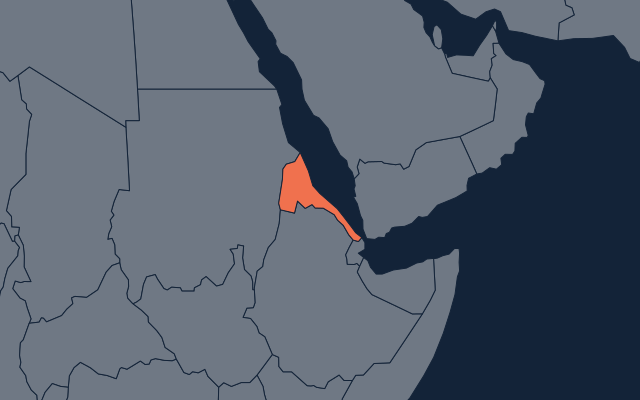
Gulf war / Hormuz · Strature analysis, not from the brief
Gulf war / Hormuz: what is at stake for Eritrea
Eritrea relies on the Middle East for about 91% of its oil (a proxy: little trade data is published), and Houthi forces were reported on islands opposite its coast in Sep 2026.
91%est.
Middle East share of oil use (IEA proxy, 2024)
64.3%
Rise in the crude price, Feb-Sep 2026
30%
Rainfall below average, 2026 season
Read the full panel
Risks
- Fuel cost. The crude price was 64.3% higher in Sep 2026 than in February. Eritrea gets almost all its oil from the region. Estimate from press or commentary
- Conflict next door. In Sep 2026 Houthi forces were reported to have taken the Zuqar and Hanish islands, about 160 km north of Bab al-Mandab, opposite the Eritrean coast. Estimate from press or commentary
- Harvest. Rain was 20-40% below average in Jun-Sep 2026, so more food may need to be imported at higher prices.
Opportunities
- Red Sea position. Bab al-Mandab, next to Eritrea's coast, carries about 12% of world trade, so the security of that coast matters more to Gulf exporters using the Red Sea. Estimate from press or commentary
- Little Gulf money to withdraw. No Gulf state deposits at Eritrea's central bank were found in public sources, so a Gulf fiscal squeeze has little direct finance to pull back. Estimate from press or commentary
Uncertainties
- No trade data by partner. The 91% figure is an IEA-based proxy, not customs data. Estimate from press or commentary
- Reserves were last published for 2019 (US$0.192bn).
What to watch
- 20 Nov 2026The registered strike forecast resolves.
- MonthlyShipping incidents near the Hanish islands and Bab al-Mandab.
- Late 2026FAO crop assessment after the poor rains.
Exposure by lens
| Lens | Figure | Band | Published line |
|---|---|---|---|
| Refined productsDependence | 91%est. 2024Middle East share of domestic oil consumption | High | High ≥40% · Medium 20–40% · Low 10–20% |
Bands follow the published materiality lines for this theme. A low-confidence figure alone caps a band at Medium.
Gulf
Drawn to scale from zero. Source: World Bank Commodity Price Data (Pink Sheet), monthly prices, October 2026 release.
Briefs and questions
- T-003 · Had Hormuz crude flows recovered by late September 2026? Products
- S-001 · Does a strike translate into a published war-risk premium? Red Sea and Bab al-Mandab
- S-001 F-0074 Renewed strike on Iran by 20 Nov 2026 (61%), our estimate, scored when it resolves.
Sources cited
- FAO GIEWS country brief: Eritrea (30 Sep 2026) (Jun-Sep 2026; retrieved 6 Oct 2026)
- World Bank WDI API, FI.RES.TOTL.CD (2019; retrieved 6 Oct 2026)
- World Bank Commodity Price Data (Pink Sheet), monthly prices, October 2026 release (2026-09; retrieved 6 Oct 2026)
Estimates from press or commentary
- Ranked: Which Countries Depend Most on Middle East Oil? (Visual Capitalist, data IEA World Energy Statistics 2024) (2024; retrieved 6 Oct 2026)
- African Red Sea states' risks grow as Houthi rebels expand reach (Asia Times, Oct 2026) (2026-09; retrieved 6 Oct 2026)
- Strature web search of public sources, 6 Oct 2026 (nearest record: Middle East Monitor, Qatar bank asks US court to order Eritrea to pay back $300m debt, 13 Aug 2021) (searched Oct 2026; retrieved 6 Oct 2026)
Our calculations
- Rise in the crude benchmark since before the war: 64.3% (= (116.8 - 71.1) / 71.1)
- Scenario: fuel import bill if prices stay at the Sep 2026 level, relative to before the war: 1.64 times the pre-war bill (= 1 + 0.643)
Strature analysis, not from the brief: researched by Strature from public sources and kept in our country dossier, updated 6 Oct 2026. General research, not advice. Who is exposed to the Gulf war / Hormuz